
Applications
Applied Domains of Structural Psychology
Structural Psychology provides a formal architecture of stabilization and transformation. Its applied form—referred to as Axiomatic Therapy in clinical and developmental contexts—translates the governing principles of necessity, derivation, and structural alignment into intervention practice.
Axiomatic Therapy does not introduce new techniques as such. Rather, it reorganizes intervention around identification and recalibration of governing necessity conditions. Techniques drawn from cognitive, behavioral, somatic, or conversational modalities may be used, but they are applied within a necessity-informed structural architecture.
The following domains illustrate the scope of application.
1. Clinical and Therapeutic Context
In clinical settings, persistent anxiety, depressive recurrence, relational conflict, and self-sabotage frequently demonstrate cross-contextual stability despite insight or behavioral effort.
Within an axiomatic framework, such persistence is examined not primarily as cognitive distortion or emotional dysregulation, but as coherence under governing necessity.
For example, chronic relational avoidance may reflect an axiom such as:
“I must not expose vulnerability in order to remain safe.”
Intervention does not focus exclusively on exposure exercises or reframing vulnerability as positive. It identifies and examines the governing necessity itself under regulatory stability.

When coherence can be maintained without the prior necessity constraint, behavioral and relational reorganization occurs without compensatory strain.
This structural approach is particularly relevant in cases where conventional cognitive or behavioral modification has produced limited durability.
2. Leadership and Executive Decision-Making
In leadership contexts, constraint density often manifests as rigid strategic thinking, defensive decision-making, or repeated organizational conflict patterns.
Executives may describe frustration with recurring dynamics despite intellectual sophistication and adaptive capacity.
Structural analysis frequently reveals governing necessity conditions such as:
“I must maintain control to preserve authority.”
“I cannot appear uncertain.”
These conditions restrict viable relational and strategic configurations.
Axiomatic intervention expands degrees of freedom at the decision-structure level. As necessity recalibrates, behavioral flexibility increases without loss of leadership coherence.
The result is not personality change, but structural realignment of stabilization conditions governing executive identity.
The axiomatic approach does not introduce new techniques as such. Rather, it reorganizes intervention around identification and recalibration of governing necessity conditions. Techniques drawn from cognitive, behavioral, somatic, or conversational modalities may be used, but they are applied within a necessity-informed structural architecture.
The following domains illustrate the scope of application.
3. Performance and Skill Acquisition
In high-performance environments—athletic, artistic, academic, or entrepreneurial—plateaus frequently persist despite training intensity.
Structural Psychology examines performance ceilings as potential manifestations of governing necessity, such as:
“If I exceed this level, I risk destabilizing my identity or relationships.”
Performance blocks may therefore reflect coherence under identity-level constraint rather than lack of ability.
When necessity is recalibrated, performance expansion often occurs without proportional increase in effort.
The axiomatic approach in performance contexts emphasizes precision mapping of stabilization mechanics rather than motivational amplification.
Executives may describe frustration with recurring dynamics despite intellectual sophistication and adaptive capacity.
Structural analysis frequently reveals governing necessity conditions such as:
“I must maintain control to preserve authority.”
“I cannot appear uncertain.”
These conditions restrict viable relational and strategic configurations.
Axiomatic intervention expands degrees of freedom at the decision-structure level. As necessity recalibrates, behavioral flexibility increases without loss of leadership coherence.
The result is not personality change, but structural realignment of stabilization conditions governing executive identity.
The axiomatic approach does not introduce new techniques as such. Rather, it reorganizes intervention around identification and recalibration of governing necessity conditions. Techniques drawn from cognitive, behavioral, somatic, or conversational modalities may be used, but they are applied within a necessity-informed structural architecture.
The following domains illustrate the scope of application.
4. Education and Learning Systems
Learning is defined as the expansion of permissible cognitive configurations within a recursively organized, constraint-governed system of consciousness.
Within Structural Psychology, intellectual performance is not determined solely by capacity, exposure, or effort, but by the necessity conditions regulating which forms of competence identity are structurally admissible without destabilizing coherence.
A learner’s difficulty is therefore not automatically interpreted as lack of ability, motivation, or instructional clarity. It may reflect stabilization under constraint.
Learning operates across recursive cognitive orders:
- Procedural cognition — attention sequencing, study strategy, task initiation.
- Belief cognition — assumptions regarding intelligence, effort, or evaluative outcome.
- Identity cognition — self-definition as capable, incapable, competent, or exposed.
- Axiomatic cognition — governing necessity conditions regulating permissible expansion.
- Systemic constraint fields — relational or evaluative structures reinforcing those necessities.
Surface resistance (procrastination, disengagement, inconsistency) may be procedural. Persistent underperformance despite comprehension, however, often indicates identity-level or axiomatic stabilization.
For example, a student may intellectually understand material yet operate under a governing necessity such as:
“If I fully apply myself and fail, I lose protection.”
“If I exceed expectations, relational equilibrium destabilizes.”
“Competence increases evaluative exposure.”
These are not merely beliefs about learning. They are structural preconditions defining what degree of intellectual expansion is permissible.
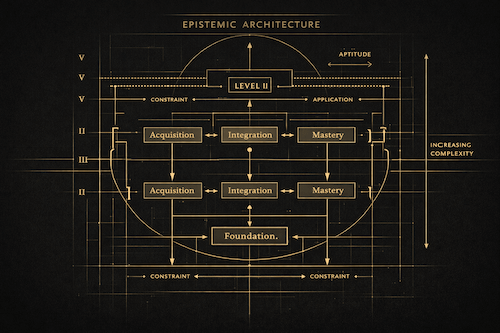
Under elevated constraint density, cognitive bandwidth narrows. Attention allocation, working memory engagement, and strategic experimentation reorganize within restricted identity boundaries. Learning becomes structurally constrained, not intellectually absent.
Traditional academic support typically intervenes at procedural or belief levels. While beneficial, such interventions may reorganize within the same governing necessity. Recurrence of disengagement or performance ceilings therefore persists.
The axiomatic approach to learning differentiates the level at which stabilization occurs. Intervention proceeds through:
- Identification of recursive cognitive order
- Differentiation of governing necessity conditions
- Analysis of formation context
- Evaluation of systemic reinforcement
- Recalibration of over-constraining axioms under coherence-preserving conditions
When governing necessity shifts, permissible competence configurations expand. Attention stabilizes. Effort increases without coercion. Performance reorganizes without proportional escalation of motivational pressure.
Learning, in this framework, is not amplified through encouragement alone. It is expanded through reduction of structural over-constraint.
Education thus becomes a problem of cognitive architecture rather than willpower.
Structural Psychology examines learning ceilings as manifestations of constraint density within consciousness. When necessity conditions recalibrate, intellectual development proceeds within expanded degrees of freedom.
5. Relationship and Conflict Dynamics
elational conflict frequently demonstrates derivational recurrence: similar disputes emerge across partners, roles, and contexts.
Structural mapping often reveals axioms such as:
“If I yield, I disappear.”
“If I assert, I will be rejected.”
These necessity conditions shape interpretive framing, emotional reactivity, and behavioral escalation.
When the governing necessity is examined and recalibrated, relational flexibility increases without suppression of authentic expression.
The shift is structural rather than tactical.
Clinical Axiomatic Therapy as Applied Architecture
Axiomatic Therapy represents the applied methodology derived from Structural Psychology.
Its defining characteristics include:
• Identification of governing necessity rather than surface content alone
• Derivational mapping across abstraction levels
• Regulatory stabilization prior to structural inquiry
• Recalibration of necessity conditions under coherence
• Measurement of durability through expansion of degrees of freedom
It does not replace cognitive, behavioral, somatic, or conversational tools. It situates them within a stabilization-informed architecture.
Where intervention is guided by structural necessity rather than symptom reduction alone, durability becomes more probable and compensatory effort decreases.
Applied Precision
The practical power of Structural Psychology lies not in intensity of intervention but in precision of stabilization analysis.
When governing necessity conditions are correctly identified and recalibrated, downstream cognitive, behavioral, and relational organization reconfigure without force.
Axiomatic Therapy therefore reflects a strategic, axiom-informed application of the broader theoretical model.
Its aim is not symptomatic suppression, but structural expansion of viable configuration space.
Its defining characteristics include:
• Identification of governing necessity rather than surface content alone
• Derivational mapping across abstraction levels
• Regulatory stabilization prior to structural inquiry
• Recalibration of necessity conditions under coherence
• Measurement of durability through expansion of degrees of freedom
It does not replace cognitive, behavioral, somatic, or conversational tools. It situates them within a stabilization-informed architecture.
Where intervention is guided by structural necessity rather than symptom reduction alone, durability becomes more probable and compensatory effort decreases.